
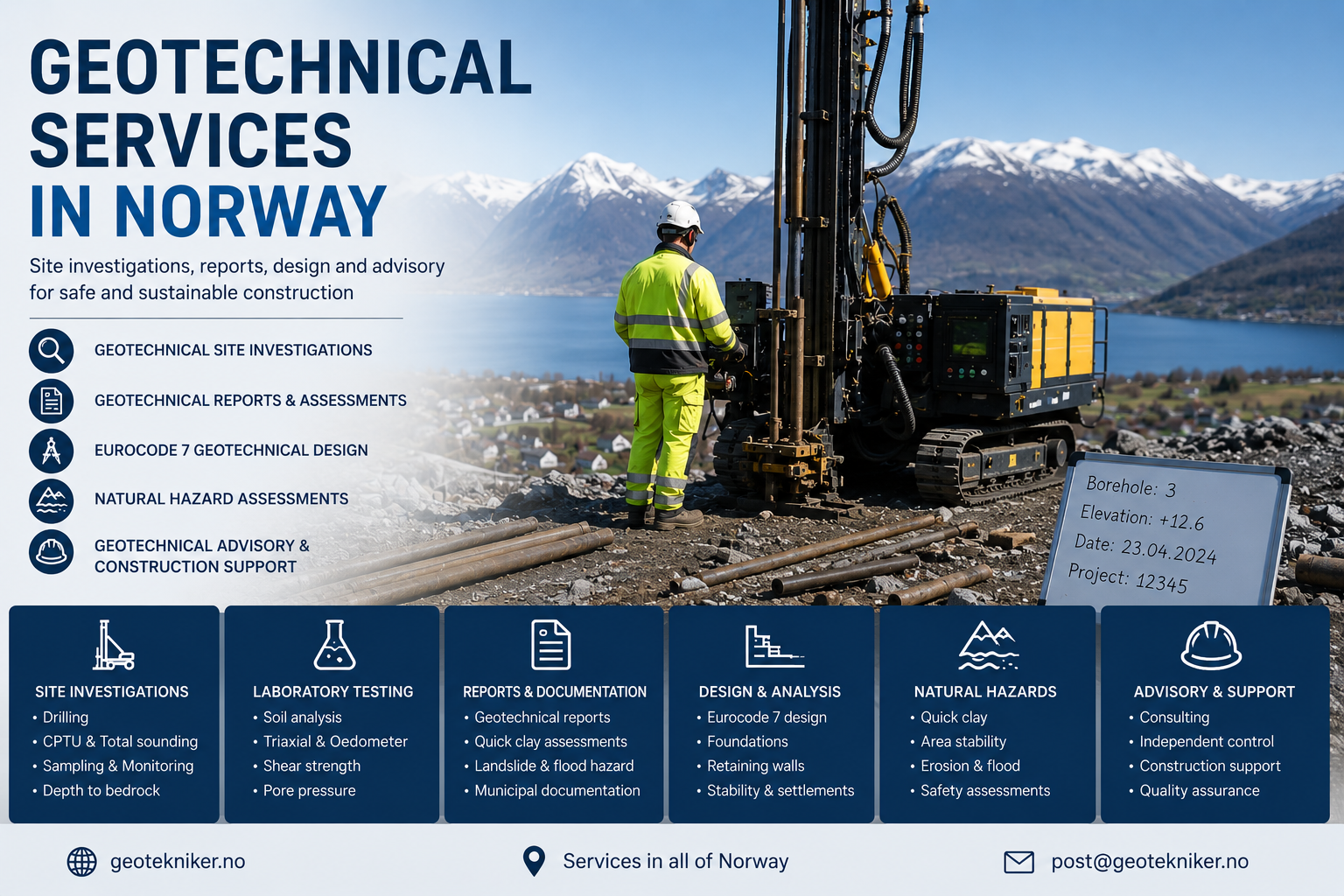
Geotekniker AS provides geotechnical services in Norway for building projects, terrain changes, foundations, retaining walls, natural hazards and construction work. We assist with geotechnical consulting, ground investigations, geotechnical reports, geotechnical site investigations, drilling, testing, Eurocode 7 design support and documentation required by Norwegian municipalities.
What is geotechnics?
Geotechnics is the engineering discipline that deals with soil, rock, groundwater and the ground conditions beneath buildings, roads, retaining walls, slopes and infrastructure.
In Norway, geotechnics is closely connected to building permits, foundation design, slope stability, quick clay, marine clay, flood hazard, erosion and natural hazard documentation. A geotechnical assessment may be required when the ground conditions can affect safety, construction cost, settlement risk, excavation work or the documentation needed by the municipality.
The Norwegian term for geotechnics is geoteknikk. For many projects, geotechnics becomes relevant when the municipality, architect, contractor or property owner needs to clarify whether the ground is suitable for the planned works.
Geotechnical engineering and engineering geology
Geotechnical engineering focuses on how soil, rock and groundwater affect construction and safety. It includes bearing capacity, settlements in soil, slope stability, earth pressure, retaining structures, piles, excavations, ground improvement and foundation design.
Engineering geology is closely related, but often focuses more on rock conditions, weak zones, fractures, weathering, rock stability and geological structures. In Norwegian building projects, geotechnical engineering and engineering geology often overlap. A site may need both a geotechnical assessment of soil conditions and a geological assessment of rock, slopes or fracture systems.
Geotekniker AS can assist with geotechnical consulting, geological investigation and geological report where the project requires a combined understanding of soil, rock and natural hazards.
Geotechnical investigation, site investigation and survey in Norway
A geotechnical investigation, geotechnical site investigation or geotechnical survey is used to clarify ground conditions before design, construction or municipal approval. The purpose is to reduce uncertainty and provide a reliable basis for geotechnical reports, foundation design and natural hazard assessments.
A geotechnical site investigation may include geotechnical drilling, total sounding, CPTU testing, sampling, trial pits, laboratory testing, groundwater or pore pressure measurements, assessment of depth to bedrock and interpretation of existing ground investigation data.
In Norway, geotechnical investigations are often relevant for new buildings, extensions, retaining walls, terrain changes, roads, excavations, fills and projects in areas with marine clay or possible quick clay.
Geotekniker AS can assess whether the project needs ground investigations, geotechnical drilling, CPTU testing, total sounding, trial pits, depth to bedrock or geotechnical laboratory testing.
Geotechnical drilling, testing and laboratory testing
Geotechnical drilling, geotechnical testing and geotechnical laboratory testing are used to obtain information about soil layers, strength, stiffness, groundwater conditions and depth to bedrock.
The correct investigation method depends on the project and the ground conditions. For simple projects, existing information, maps, previous reports and local knowledge may sometimes be enough for an initial assessment. For more complex projects, field investigations and laboratory data may be needed.
Geotechnical drilling can be used to investigate soil layers, relative resistance, depth to bedrock and possible weak layers. Laboratory testing can be used to determine water content, density, strength, deformation properties and other soil parameters.
Relevant methods and topics include geotechnical drilling, geotechnical laboratory testing, triaxial testing, oedometer testing, soil strength and shear strength, friction angle, pore pressure and groundwater.
Geophysical and geotechnical investigations
Geophysical methods can sometimes be useful as a supplement to geotechnical investigations. They may help indicate changes in ground conditions, bedrock level, weak zones or larger-scale geological features.
However, geophysical methods normally do not replace geotechnical drilling, sampling or laboratory testing when a project requires documented soil parameters, foundation design or formal geotechnical documentation. In most building projects, geophysical data must be interpreted together with geotechnical and geological information.
A good investigation strategy should be adapted to the question the project needs to answer. Sometimes the key question is depth to bedrock. In other cases, the most important issue is quick clay, slope stability, settlement risk, groundwater, bearing capacity or the need for documentation in a building permit process.
Geotechnical report and documentation
A geotechnical report documents ground conditions, relevant risks and the geotechnical basis for the project. The content can vary from a simplified assessment to a more detailed report with calculations, design assumptions and recommendations.
A geotechnical report may be required for:
- new buildings
- extensions
- retaining walls
- terrain changes
- fills and excavations
- foundations
- construction below the marine limit
- projects near slopes
- projects near streams or rivers
- areas with possible marine clay or quick clay
- natural hazard documentation under TEK17
Norwegian municipalities may use different wording when they request documentation. Some ask for a geotechnical report. Others ask for a geotechnical assessment, geotechnical statement, geotechnical note, ground assessment, quick clay assessment, area stability assessment or documentation of safety against natural hazards.
Geotekniker AS can assist with geotechnical report and assessment, quick clay report, landslide hazard assessment, flood hazard assessment and stormwater report, depending on the project and the municipal requirement.
Eurocode 7 geotechnical design
Geotechnical design in Norway is normally based on Eurocode 7, implemented through Norwegian standards and national requirements. Eurocode 7 is relevant when geotechnical conditions affect the design of foundations, retaining structures, slopes, excavations, piles, fills or other structures.
Eurocode 7 geotechnical design may include assessment of:
- bearing capacity
- settlements in soil
- slope stability
- earth pressure
- retaining walls and geotechnics
- sheet piling
- piles
- excavations
- ground improvement
- groundwater conditions
- design parameters for soil and rock
The design basis must match the project, the ground conditions and the consequences of failure. A small retaining wall on good ground does not require the same level of documentation as a larger structure in soft clay, near a slope or in an area with possible quick clay.
Geotekniker AS can assist with geotechnical design / RIG, foundations, bearing capacity, settlements in soil, retaining walls and geotechnics and sheet piling.
Geotechnical construction support and ground engineering
Geotechnical construction support is relevant when ground conditions affect excavations, fills, retaining walls, foundations, slopes, groundwater or neighbouring structures during construction.
This may be relevant for excavation, filling, retaining walls, temporary slopes, groundwater lowering, compaction, ground improvement, foundations, sprengstein fill and work close to neighbouring buildings or slopes.
In some projects, the geotechnical role is mainly to provide early advice. In other projects, the role may include design support, review of documentation, independent control or follow-up of ground-related issues during construction.
Geotekniker AS can assist with geotechnical control, independent control, geotechnical design and geotechnical consulting.
Geotechnics and geohazards in Norway
Norwegian ground conditions can be challenging. Many areas are affected by marine clay, quick clay, steep terrain, erosion, flood paths, groundwater and previous human activity such as fills, excavations and terrain changes.
Geotechnical services in Norway may therefore include natural hazard assessments. This is especially relevant for building projects where the municipality requires documentation of safety against landslides, floods, erosion or quick clay-related area stability.
Important geohazards and ground-related topics include:
- quick clay
- quick clay zones
- area stability
- quick clay hazard class
- marine clay
- marine limit
- landslides
- rockfall
- flood hazard
- erosion
- slope stability
- groundwater and pore pressure
- terrain changes
- fills and excavations
Geotekniker AS works with natural hazards, quick clay, area stability, erosion, safety against landslides and safety against flood where this is relevant for the project.
Geotechnical services from Geotekniker AS
Geotekniker AS provides geotechnical services in Norway for private clients, developers, contractors, architects, consultants and public-sector clients.
We can assist with:
- geotechnical assessments
- geotechnical site investigations
- geotechnical surveys
- geotechnical drilling
- geotechnical testing
- geotechnical laboratory testing
- geotechnical reports
- quick clay assessments
- area stability assessments
- natural hazard documentation
- foundation and retaining wall assessments
- Eurocode 7 design support
- independent control
- review of municipal requirements
- assessment of existing geotechnical documentation
Our work is adapted to the project. Some cases require a limited initial assessment. Other cases require field investigations, calculations, design documentation or coordination with other disciplines.
Related geotechnical resources in Norwegian
Most of our detailed technical resources are written in Norwegian, because Norwegian municipalities, building regulations and geotechnical documentation are normally handled in Norwegian. The links below may be useful for clients, architects, contractors and consultants who want to understand Norwegian terminology.
Main geotechnical services
- geotechnical consulting
- geotechnical report and assessment
- ground investigations
- geotechnical design / RIG
- independent control
- quick clay report
- landslide hazard assessment
- flood hazard assessment
- stormwater report
- geological investigation
- geological report
Site investigations, drilling and testing
- geotechnical drilling
- CPTU testing
- total sounding
- trial pits
- depth to bedrock
- geotechnical laboratory testing
- triaxial testing
- oedometer testing
- pore pressure
- groundwater
Soil properties and ground conditions
- soil strength and shear strength
- friction angle
- bearing capacity
- settlements in soil
- settlement damage
- earth pressure
- soft ground
- fill materials
- sprengstein fill
- clay
- silt
- sand
Foundations, retaining structures and construction
- foundations
- retaining walls and geotechnics
- sheet piling
- terrain changes
- geotechnical construction support
- geotechnical control
Natural hazards and Norwegian ground conditions
- natural hazards
- quick clay
- quick clay zones
- area stability
- quick clay hazard class
- marine clay
- marine limit
- erosion
- safety against landslides
- safety against flood
- planning hazard zones
Contact Geotekniker AS
Send us the project address, cadastral number, drawings, photos, municipal letter or a short description of the project. We can assess what type of geotechnical documentation may be required in Norway and what the next step should be.
Relevant services include geotechnical consulting, ground investigations, geotechnical report and assessment, geotechnical design / RIG, quick clay report, landslide hazard assessment, flood hazard assessment, stormwater report and independent control.
FAQ
What are geotechnical services?
Geotechnical services include assessment of soil, rock, groundwater and ground-related risks. This may involve site investigations, geotechnical reports, foundation assessments, slope stability, retaining structures, quick clay, natural hazards and Eurocode 7 design support.
When is a geotechnical report required in Norway?
A geotechnical report may be required when ground conditions can affect safety, design or municipal approval. This is common for buildings, extensions, retaining walls, terrain changes, foundations, slopes, marine clay, quick clay and natural hazard documentation.
What is a geotechnical site investigation?
A geotechnical site investigation is used to clarify ground conditions. It may include drilling, CPTU testing, total sounding, sampling, groundwater measurements and laboratory testing.
Is a geotechnical survey the same as a geotechnical investigation?
The terms geotechnical survey, geotechnical investigation and geotechnical site investigation are often used in similar ways. The exact meaning depends on the project, the requested documentation and the methods used.
What is geotechnical drilling?
Geotechnical drilling is used to investigate soil layers, resistance, depth to bedrock, possible weak layers and ground conditions that may affect construction, stability or foundation design.
What is geotechnical laboratory testing?
Geotechnical laboratory testing is used to determine soil properties such as water content, density, strength, deformation properties and other parameters needed for assessment or design.
What is the difference between geotechnics and geotechnical engineering?
Geotechnics is the broader field dealing with soil, rock and groundwater. Geotechnical engineering is the engineering application of this knowledge in design, construction, foundations, stability, settlements and risk assessment.
How is Eurocode 7 used in geotechnical design?
Eurocode 7 provides the framework for geotechnical design. It is used for foundations, bearing capacity, settlements, slopes, retaining structures, piles, excavations and other ground-related design issues.
Can geotechnical services include quick clay and natural hazards?
Yes. In Norway, geotechnical services often include assessment of quick clay, marine clay, area stability, landslides, erosion, flood hazard and other natural hazards where these issues affect building projects or municipal documentation.
Do I need a geotechnical investigation before building in Norway?
Not every project needs a new geotechnical investigation. The need depends on the project, the ground conditions, previous documentation, municipal requirements and the risk level. An initial assessment can help clarify whether existing information is sufficient.
Can foreign clients order geotechnical services in Norway?
Yes. Foreign property owners, developers, architects, contractors and consultants can order geotechnical services in Norway. Geotekniker AS can review the project basis and explain what type of documentation may be required.

Fagansvarlig geotekniker og daglig leder i Geotekniker AS. Han har M.Sc. i faststoffmekanikk (UiO) med videreutdanning i geoteknikk (NTNU, OsloMet) og hydrologi (NMBU). Han har 20 års ingeniørerfaring, blant annet fra Det Norske Veritas, hvorav de siste 12 årene er innen geoteknikk, blant annet som kommunegeotekniker i Lørenskog kommune og i Bane NOR. Geotekniker AS har sentral godkjenning fra DiBK i tiltaksklasse 3.