
Geotechnical contractors are typically involved in piling, excavation support, ground improvement and other specialist groundworks.
In Norway, these projects often require geotechnical investigations, engineering design and technical documentation before construction can begin.
Geotekniker AS provides independent geotechnical engineering support for developers, construction companies and property owners throughout Norway. We assist with ground assessments, engineering design and documentation, while physical construction works are performed by specialist contractors.
What Does a Geotechnical Contractor Do?
Geotechnical contractors carry out specialist ground engineering works where soil conditions, groundwater or stability can affect the construction process.
Typical activities include:
- Piling and deep foundations – transferring structural loads to suitable ground or bedrock.
- Sheet piling and excavation support – securing excavations and nearby structures.
- Ground improvement – improving weak or compressible soils.
- Earthworks and slope stabilisation – managing ground stability during construction.
- Groundwater control – handling groundwater where it affects excavation or foundation works.
Construction methods must be adapted to the ground conditions and approved technical design.
Specialist works such as pile foundations and sheet piling often require detailed geotechnical assessments before execution.
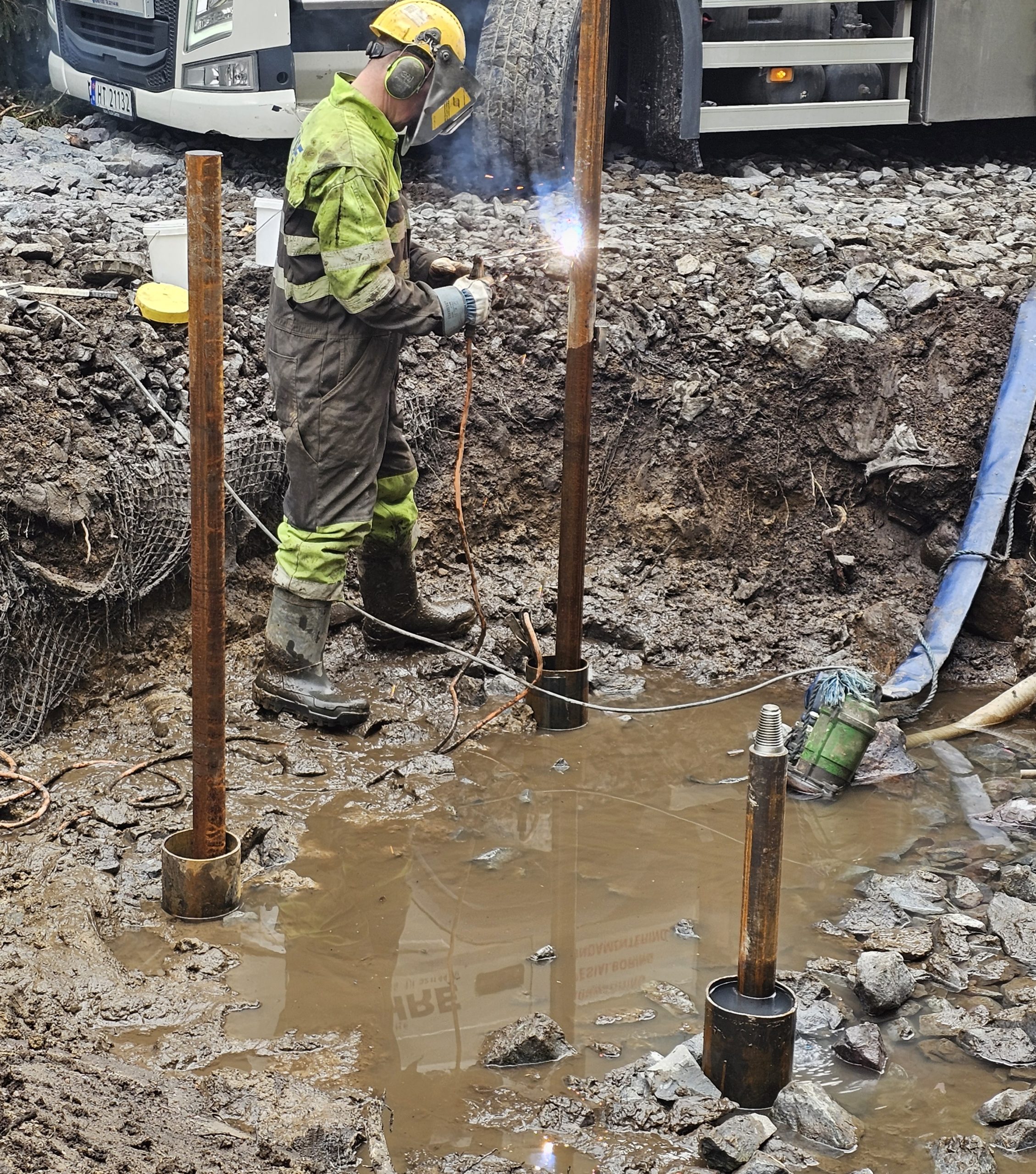
Picture above: In 2026, Geotekniker AS worked on ground-related assessments in Maridalen, Oslo, where large bedrock depth was a key geotechnical challenge. The project involved foundation works for a high-voltage transmission mast, where the foundation had to resist significant overturning moments. Due to the ground conditions and the structural demands, the works included steel core piles to bedrock as part of the foundation solution. This type of project illustrates how geotechnical engineering, foundation design and construction execution must work together when ground conditions are demanding and structural loads are high.
Geotechnical Contractors vs. Geotechnical Engineering Companies
Although the terms are closely related, geotechnical contractors and geotechnical engineering companies normally have different responsibilities.
A geotechnical contractor performs physical construction works, while a geotechnical engineer investigates ground conditions, evaluates risks and prepares technical design documentation.
For example, a contractor may install sheet piles around an excavation. The geotechnical engineer assesses earth pressures, groundwater conditions, stability and the design requirements for the retaining structure.
A project may therefore require both a specialist contractor and an independent engineering consultant.
Geotekniker AS provides geotechnical consulting and engineering assessments to support safe planning, design and execution.
Geotechnical Site Investigation Before Construction
Reliable ground information is essential before selecting construction methods or foundation solutions.
A geotechnical site investigation may involve drilling, soil sampling, field testing and laboratory analysis. The investigation scope depends on the planned works and the uncertainty of the ground conditions.
In Norway, particular challenges may include soft marine clay, quick clay, variable bedrock depth, groundwater and sloping terrain.
Professional geotechnical ground investigations provide information needed to assess bearing capacity, settlement risks, foundation alternatives and ground stability.
Geotechnical Foundation Design and Excavation Support
Geotechnical foundation design determines how structural loads can be transferred safely to the ground. The appropriate solution depends on soil properties, structural loads, settlement requirements and groundwater conditions.
Possible solutions include shallow foundations, piled foundations or ground improvement measures.
Geotechnical assessments are also important when construction involves deep excavations, retaining structures or works close to existing buildings.
Both permanent and temporary stability must be considered. Excavation methods that appear straightforward may require additional engineering where neighbouring structures, groundwater or weak soils increase the risks.
Read more about foundation engineering and ground conditions and geotechnical excavation assessments.
Geotechnical Design and Documentation in Norway
Ground engineering projects in Norway must satisfy relevant technical and regulatory requirements.
Eurocode 7, including applicable Norwegian national annexes, provides a framework for geotechnical design. Requirements under TEK17 may also apply, including structural safety and stability during construction and in the completed works.
Depending on the project, geotechnical design and engineering calculations may be required for foundations, excavations, retaining structures or stability measures.
A geotechnical report can document the ground conditions, engineering assumptions and relevant assessments needed for construction planning or building applications.
The necessary documentation depends on project complexity, ground conditions and the applicable requirements.
Ground Stability and Quick Clay During Construction
Geotechnical construction in Norway may involve sensitive clay or quick clay deposits, particularly in areas below the marine limit.
Excavation, filling, temporary loading and changes in groundwater conditions can influence stability. The consequences must be assessed before potentially destabilising works begin.
Where relevant, an area stability assessment may be necessary to document that the planned works satisfy applicable safety requirements.
The contractor must also follow the relevant design assumptions and construction restrictions.
Geotechnical Monitoring and Construction Support
Actual ground conditions encountered during construction may differ from the available investigation results.
Unexpected soil layers, groundwater conditions or ground movements can require additional engineering assessments or adjustments to the construction method.
Depending on the project, monitoring may include settlement measurements, groundwater observations or deformation measurements.
Independent geotechnical site supervision can help assess whether observed conditions and construction activities remain consistent with the engineering design.
Technical follow-up does not replace the contractor’s responsibility for proper execution and quality control.
Choosing a Geotechnical Contractor in Norway
When selecting geotechnical contractors, developers should consider experience with similar ground conditions, appropriate equipment, construction methods and quality documentation.
For technically demanding projects, early involvement of an independent geotechnical engineer can help clarify the necessary design basis, construction restrictions and documentation requirements.
The objective is to ensure that the selected construction method is compatible with the actual ground conditions and the approved design.
Geotechnical Engineering Support – Geotekniker AS
Geotekniker AS provides professional geotechnical assessments, engineering design, investigation planning and technical documentation throughout Norway.
We support developers, construction companies and property owners with foundation assessments, excavation stability, retaining structures, settlement risks and other ground engineering challenges.
Our role is independent geotechnical engineering rather than physical construction execution.
Learn more about our geotechnical services in Norway.
Do you need geotechnical engineering support for your construction project?
Contact Geotekniker AS with your project location, available drawings and a brief description of the planned works. We can assess the relevant engineering and documentation requirements.
Frequently Asked Questions
What is a geotechnical contractor?
A geotechnical contractor is a specialist construction company performing ground engineering works such as piling, excavation support, ground improvement and soil stabilisation.
What is the difference between a geotechnical contractor and a consultant?
A contractor executes construction works, while a geotechnical consultant provides investigations, engineering assessments, technical design and documentation.
Do geotechnical contractors need ground investigations?
Ground investigations may be necessary when existing information is insufficient to establish suitable and safe construction methods.
Can Geotekniker AS assist construction contractors?
Yes. Geotekniker AS provides independent geotechnical engineering, design, assessments and technical documentation for construction projects throughout Norway.
Read more about Geotekniker AS and its technical expertise.

Fagansvarlig geotekniker og daglig leder i Geotekniker AS. Han har M.Sc. i faststoffmekanikk (UiO) med videreutdanning i geoteknikk (NTNU, OsloMet) og hydrologi (NMBU). Han har 20 års ingeniørerfaring, blant annet fra Det Norske Veritas, hvorav de siste 12 årene er innen geoteknikk, blant annet som kommunegeotekniker i Lørenskog kommune og i Bane NOR. Geotekniker AS har sentral godkjenning fra DiBK i tiltaksklasse 3.