
In Norway, Eurocode 7 (NS-EN 1997) is applied together with the relevant Norwegian National Annexes to document ground stability, bearing capacity, settlement and structural safety.
Geotekniker AS provides geotechnical design services throughout Norway, including engineering calculations, foundation design, stability assessments and technical documentation for residential, commercial and infrastructure projects.
What is Eurocode 7 geotechnical design?
Eurocode 7 establishes principles and requirements for geotechnical engineering and the interaction between structures and ground conditions.
The currently applicable first-generation standard consists of two main parts.
EN 1997-1 – General rules addresses geotechnical design, including foundations, retaining structures, stability, engineering verification and serviceability.
EN 1997-2 – Ground investigation and testing addresses the use of ground investigations, field and laboratory testing, and geotechnical information in engineering design.
Eurocode 7 is applied alongside EN 1990, which establishes the general basis for structural design and reliability.
In Norway, Eurocode 7 is known as Eurokode 7 – geoteknisk prosjektering. For a broader explanation of the Norwegian standards system, see our guide to Eurocodes and geotechnical engineering.
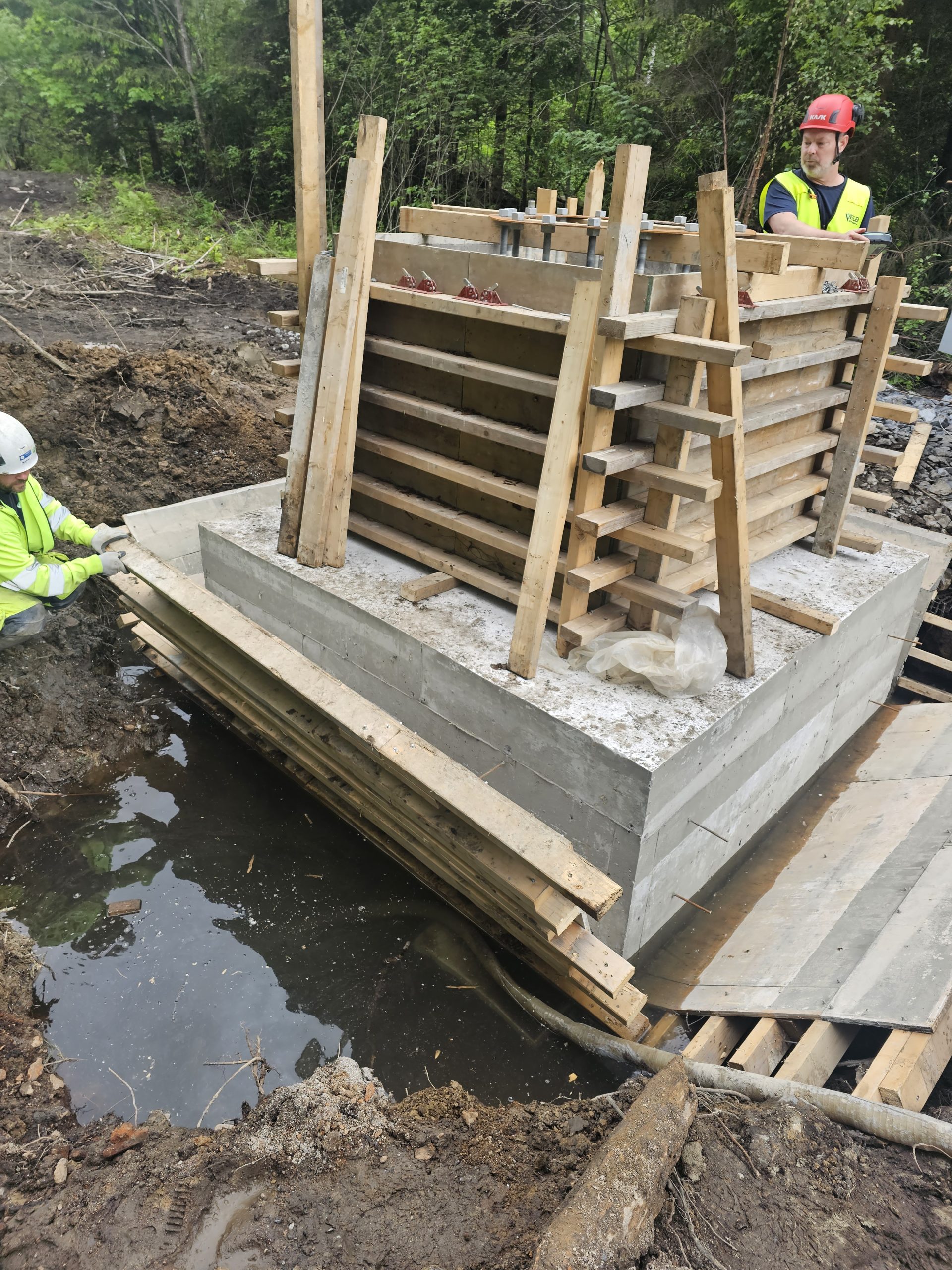
Picture above: Foundation construction for high-voltage transmission pylons in Maridalen, Oslo, where challenging ground conditions included sensitive clay with brittle-fracture behaviour (sprøbruddleire) and artesian groundwater pressure. Bedrock was located approximately 30 metres below ground level, requiring steel-core piles extending to bedrock. The project illustrates the importance of soil stability, groundwater pressure and appropriate foundation solutions in Eurocode 7 geotechnical design under challenging Norwegian ground conditions.
Eurocode 7 geotechnical design requirements
Geotechnical design must demonstrate that the proposed construction provides adequate safety and performance under relevant loading and ground conditions.
The engineering assessment typically addresses bearing capacity, overall stability, earth pressure, groundwater effects, settlement and ground deformation.
Design verification includes ultimate limit states (ULS) and serviceability limit states (SLS).
The applicable design situations, load combinations, partial factors and geotechnical parameters must be established in accordance with the relevant Eurocodes and Norwegian National Annexes.
An important part of the design process is determining whether the available ground information is sufficient to support the proposed engineering solution.
Eurocode 7 geotechnical categories
Eurocode 7 distinguishes between three geotechnical categories, commonly designated GC1, GC2 and GC3.
Geotechnical Category 1 – GC1
GC1 generally covers small and relatively simple structures with straightforward ground conditions and negligible geotechnical risk.
Simplified approaches may be appropriate where the applicable conditions for this category are satisfied.
Geotechnical Category 2 – GC2
GC2 covers conventional foundations and geotechnical structures without exceptional risks or particularly difficult ground conditions.
Quantitative geotechnical investigations, engineering calculations and documented design verification are normally required.
Geotechnical Category 3 – GC3
GC3 applies to projects involving unusual structures, particularly difficult ground conditions or significant geotechnical risks falling outside GC1 and GC2.
These projects may require more extensive investigations, advanced analyses and project-specific engineering verification.
Geotechnical categories under Eurocode 7 are not equivalent to Norwegian tiltaksklasser. They must also be distinguished from reliability classes and design-checking requirements.
The appropriate geotechnical category is determined by the specific project and may need reassessment as additional information becomes available.
Geotechnical foundation design according to Eurocode 7
Geotechnical foundation design involves evaluating how structural loads are transferred safely to the underlying soil or rock.
The assessment may include shallow foundations, raft foundations, pile foundations and ground improvement measures.
Relevant engineering considerations include bearing resistance, settlement, differential settlement, groundwater conditions and the interaction between the foundation and surrounding ground.
The selection of a suitable foundation system depends on the building loads and site-specific ground conditions.
For further information, see our guide to foundation engineering and foundation solutions.
Retaining wall and excavation design
Eurocode 7 is also relevant to retaining walls, sheet pile walls, excavations and other structures supporting or modifying ground conditions.
Design considerations include earth pressure, groundwater pressure, structural loading, deformation and overall ground stability.
For geotechnical retaining wall design, the engineer must assess the relevant failure mechanisms and verify that the selected structure satisfies the applicable requirements.
Excavations may introduce additional risks, particularly where neighbouring buildings, groundwater or weak soil conditions influence stability.
Temporary support, construction stages and necessary safety measures must therefore be considered as part of the excavation design and construction pit assessment.
Where a project involves quick clay or potentially unstable slopes, separate assessment of area stability and quick-clay hazards may also be required under Norwegian regulations.
Eurocode 7 geotechnical investigation and modelling
Reliable Eurocode 7 geotechnical design requires adequate knowledge of subsurface conditions.
A geotechnical investigation may involve borehole drilling, in-situ testing, soil sampling, laboratory testing and evaluation of available geological information.
The results are used to establish engineering parameters such as soil strength, stiffness, density, stratigraphy and groundwater conditions.
The extent of geotechnical ground investigations should reflect the complexity of the project and the uncertainty associated with the ground conditions.
Geotechnical modelling may be used where more detailed analyses of deformation, stability or soil–structure interaction are necessary. Numerical modelling does not replace the need for reliable input parameters and engineering judgement.
Eurocode 7 geotechnical design worked examples
Eurocode 7 geotechnical design worked examples illustrate how structural loads, ground parameters and engineering calculations are combined to evaluate a proposed construction solution.
Example 1 – Foundation bearing pressure
Consider a square foundation measuring 3 × 3 metres carrying a centred characteristic vertical load of 900 kN.
The average characteristic contact pressure, considering only this load, is:
q = 900 kN / 9 m² = 100 kPa
This preliminary result does not demonstrate compliance with Eurocode 7.
The actual design requires the appropriate load combinations, partial factors, bearing resistance and settlement assessment. Load eccentricity, groundwater conditions and other relevant effects must also be considered.
The available bearing capacity of the ground must be evaluated using suitable geotechnical parameters.
Example 2 – Retaining structure stability
For a retaining structure, geotechnical design requires establishing relevant earth and groundwater pressures and assessing the resistance and stability of the selected solution.
The applicable checks depend on the structure, ground conditions, construction stages and loading situations.
These simplified worked examples illustrate basic engineering considerations. They are not complete Eurocode 7 design calculations and cannot replace project-specific verification.
Eurocode 7 and Norwegian building regulations
Geotechnical design in Norway must satisfy applicable requirements under the Planning and Building Act and the Norwegian Building Regulations (TEK17).
TEK17 Section 10-2 – Structural safety establishes requirements for mechanical resistance and stability, including relevant ground conditions and safety measures during construction and in the completed structure.
The Eurocodes with Norwegian National Annexes provide a recognised method for documenting compliance with these requirements.
As of October 2026, Standard Norge identifies the following applicable consolidated editions:
NS-EN 1997-1:2004+A1:2013+NA:2025 – General rules.
NS-EN 1997-2:2007+NA:2008 – Ground investigation and testing.
According to Standard Norge, the second generation of Eurocodes is planned for publication in Norway in 2028. Until the transition, the applicable first-generation standards remain in use.
The relevant standard editions and national requirements must always be confirmed for the individual project.
Geotechnical design calculations and reports
The required documentation for Eurocode 7 geotechnical design depends on the construction project, ground conditions and design stage.
Typical deliverables include documented design assumptions, ground models, bearing capacity and settlement calculations, stability analyses, foundation recommendations and technical specifications.
The work may also include drawings, requirements for construction execution, inspection criteria and geotechnical follow-up.
The engineering results are normally documented in a written design note, calculation report or project-specific technical report.
Where the scope of detailed engineering has not yet been established, an initial geotechnical assessment and report may be appropriate.
Eurocode 7 geotechnical design PDF
Eurocode 7 standards and Norwegian National Annexes are available through authorised standards organisations.
The applicable versions of NS-EN 1997 can be found through Standard Norge’s Eurocode collection.
A general Eurocode 7 geotechnical design PDF, worked example or calculation template does not replace the project-specific engineering assessment required to document structural safety.
Eurocode 7 geotechnical design services – Geotekniker AS
Geotekniker AS provides geotechnical engineering services for residential developments, commercial buildings, infrastructure and other construction projects throughout Norway.
Our services include foundation engineering, geotechnical calculations, ground stability assessments, retaining structures and technical design documentation.
Geotekniker AS holds Norwegian central approval (sentral godkjenning) for geotechnical design in tiltaksklasse 3.
We assist property developers, contractors, architects, consulting engineers and public-sector clients with project-specific engineering documentation.
Read more about our Norwegian geotechnical design and RIG services.
Request Eurocode 7 geotechnical design in Norway
Do you need geotechnical design calculations, foundation engineering or technical documentation according to Eurocode 7?
Contact Geotekniker AS with information about the project location, proposed construction and any available ground investigation reports.
We can assess the required design scope and provide a quotation for the relevant geotechnical engineering services.
Frequently Asked Questions – Eurocode 7 Geotechnical Design
Is Eurocode 7 mandatory in Norway?
Eurocode 7, together with the relevant Norwegian National Annexes, is the recognised standard for geotechnical design in Norway. Under TEK17, alternative methods may be used if equivalent structural safety is documented, but Eurocode-based design is normally the practical approach.
What is the difference between Eurocode 7 Part 1 and Part 2?
Eurocode 7 Part 1 (EN 1997-1) establishes general geotechnical design rules, including stability, foundations and retaining structures. Part 2 (EN 1997-2) addresses ground investigation, testing and interpretation of geotechnical information.
What are the three Eurocode 7 geotechnical categories?
Eurocode 7 defines three geotechnical categories: GC1 for relatively simple projects with negligible geotechnical risk, GC2 for conventional geotechnical structures and GC3 for unusually complex or high-risk projects. The appropriate category depends on the construction and ground conditions.
Are ground investigations required for Eurocode 7 design?
Adequate ground information is necessary for reliable geotechnical design. New investigations are not always required if existing information is sufficient, but additional drilling, sampling or testing may be necessary depending on project complexity and uncertainty.
What does a Eurocode 7 geotechnical design report include?
A geotechnical design report typically documents ground conditions, design assumptions, engineering parameters, relevant calculations and selected construction solutions. The scope depends on the project and may include foundation design, stability analyses and requirements for construction execution.
Where can I find a Eurocode 7 geotechnical design PDF?
Eurocode 7 standards, including the applicable Norwegian National Annexes, can be obtained through Standard Norge. General design examples and PDF guides do not replace project-specific geotechnical engineering calculations.
Who can provide Eurocode 7 geotechnical design in Norway?
Geotechnical design should be carried out by professionals with qualifications appropriate to the project’s complexity and applicable requirements. Geotekniker AS provides Eurocode 7 geotechnical design, including foundation assessments, stability calculations and engineering documentation throughout Norway.
Contact Geotekniker AS to discuss your project.

Fagansvarlig geotekniker og daglig leder i Geotekniker AS. Han har M.Sc. i faststoffmekanikk (UiO) med videreutdanning i geoteknikk (NTNU, OsloMet) og hydrologi (NMBU). Han har 20 års ingeniørerfaring, blant annet fra Det Norske Veritas, hvorav de siste 12 årene er innen geoteknikk, blant annet som kommunegeotekniker i Lørenskog kommune og i Bane NOR. Geotekniker AS har sentral godkjenning fra DiBK i tiltaksklasse 3.