
It provides the engineering basis for safe foundations, excavations, retaining structures and slope stability.
In Norway, geotechnical engineering is particularly important due to challenging ground conditions, soft marine clay, quick clay and significant variations in terrain and bedrock depth.
A professional geotechnical assessment helps identify ground-related risks, determine suitable engineering solutions and establish the documentation required for construction and building permit applications.
What Is Geotechnical Engineering?
Geotechnical engineering applies principles of soil mechanics, engineering geology and structural engineering to understand how the ground responds to loading, excavation and changes in groundwater conditions.
The discipline includes assessment of bearing capacity, settlement, shear strength, earth pressure and ground stability.
In Norway, geotechnical engineering is known as geoteknikk. A geotechnical engineer is commonly referred to as a geotekniker or rådgivende ingeniør geoteknikk (RIG).
Geotechnical engineering is essential for ensuring that buildings and infrastructure are designed with sufficient consideration of the ground conditions beneath and around them.
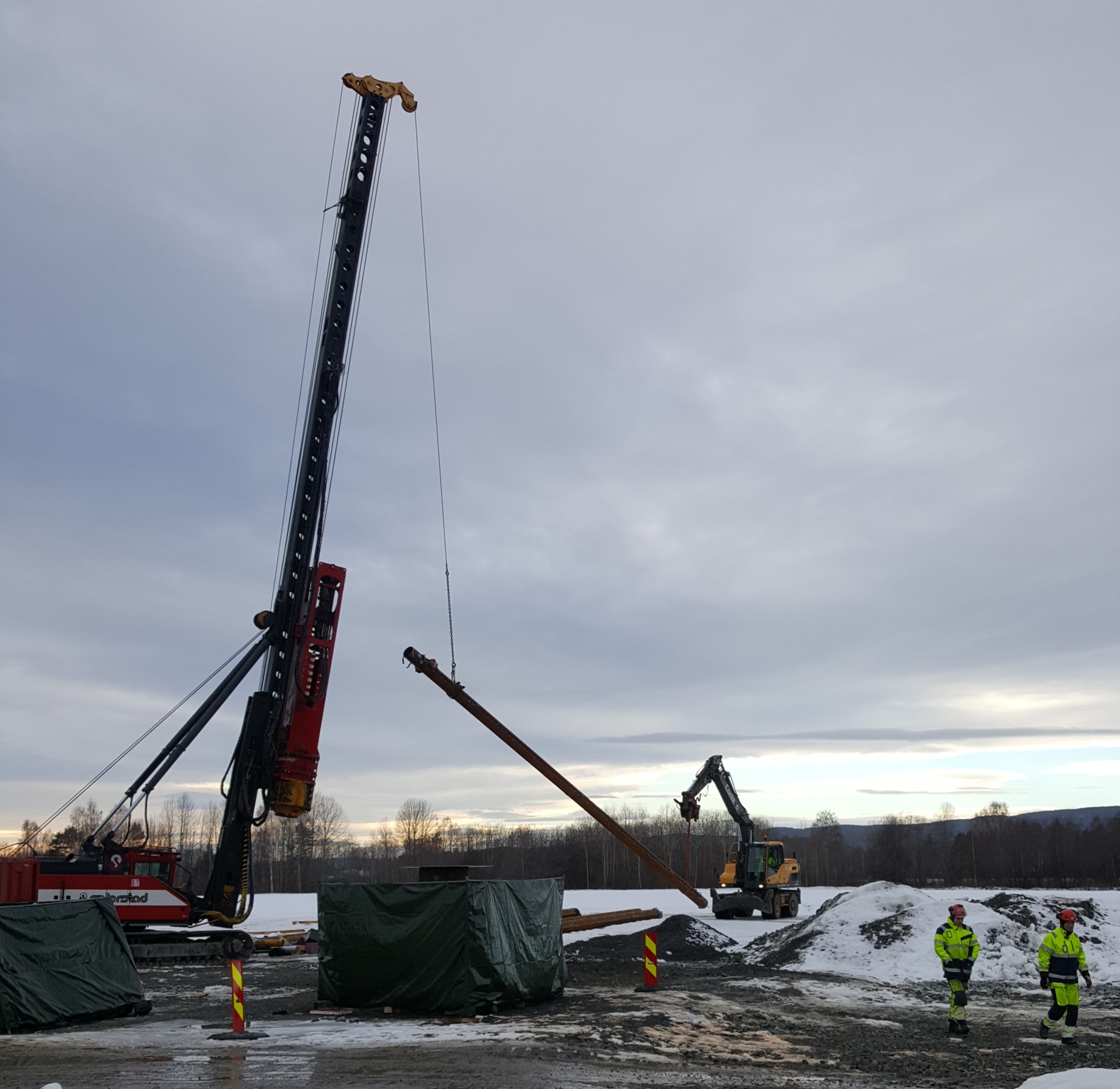
Photo above: Geotechnical Engineering in Practice – Ringeriksbanen, 2019. This photograph documents test piling carried out in 2019 for the Ringeriksbanen railway project in Norway. Test piling is an important part of geotechnical engineering, providing practical information about pile installation, equipment performance and the interaction between foundations and ground conditions. Such field experience highlights the importance of combining geotechnical investigations, engineering calculations and on-site observations when developing reliable foundation solutions.
What Does a Geotechnical Engineer Do?
A geotechnical engineer evaluates ground conditions and determines how they may affect a planned construction project.
Typical responsibilities include assessing foundation conditions, evaluating settlement and bearing capacity, analysing slope stability and identifying risks associated with excavations, retaining structures and earthworks.
The work may involve geotechnical investigation, engineering calculations, geotechnical modelling and preparation of technical documentation.
Early involvement of a geotechnical engineer can reduce uncertainty and help prevent costly changes during construction.
Geotekniker AS provides professional geotechnical consulting for property owners, developers, contractors and engineering consultants throughout Norway.
Geotechnical Investigation and Testing
Reliable geotechnical engineering depends on sufficient knowledge of subsurface conditions.
A geotechnical investigation may begin with geological maps, existing borehole records, terrain data and previous reports. Where this information is insufficient, field investigations may be necessary.
Common methods include geotechnical drilling, cone penetration testing (CPTU), soil sampling and groundwater measurements.
Professional geotechnical site investigations help establish soil stratigraphy, depth to bedrock and relevant engineering properties.
Geotechnical Laboratory Testing
Geotechnical laboratory testing provides additional information about soil strength, compressibility, water content and other relevant properties.
Laboratory results are especially useful when assessing soft clay, settlement, foundation conditions and slope stability.
The necessary scope of geotechnical laboratory investigations depends on the project’s requirements and the uncertainty associated with the ground conditions.
Geophysical and Geotechnical Methods
Geophysical and geotechnical methods can complement each other when investigating the ground.
Geophysical investigations provide indirect information about subsurface conditions, while geotechnical drilling, sampling and testing provide more direct measurements of engineering properties.
Combining these methods may improve the understanding of complex ground conditions, particularly where geological variations affect construction planning.
Geotechnical and Foundation Engineering
Geotechnical and foundation engineering are closely connected. Buildings, retaining walls and other structures must transfer loads safely to the underlying soil or bedrock.
Geotechnical foundation design considers bearing capacity, settlement, groundwater conditions and the interaction between foundations and surrounding ground.
Depending on the site, suitable solutions may include shallow foundations, piled foundations, ground improvement or other engineering measures.
A geotechnical assessment of foundation conditions can help establish whether the proposed foundation solution is appropriate or requires further investigation.
Engineering Geology and Geotechnics
Engineering geology and geotechnics are related disciplines with different technical emphasis.
Engineering geology primarily focuses on geological formations, rock masses, discontinuities and geological processes that influence construction.
Geotechnical engineering focuses on the mechanical behaviour of soil and rock, including strength, deformation and stability.
Many construction projects require an understanding of both disciplines, particularly where foundations, excavations or slopes involve varying soil and bedrock conditions.
Learn more about engineering geology in construction projects and its relationship with geotechnical assessments.
Eurocode 7 Geotechnical Design in Norway
Geotechnical engineering in Norway is generally undertaken according to applicable Eurocodes and Norwegian national annexes.
Eurocode 7 geotechnical design (NS-EN 1997) establishes a framework for investigations, analysis and design of geotechnical structures.
Depending on the project, geotechnical design may include foundation calculations, slope stability analysis, earth pressure calculations and numerical geotechnical modelling.
Requirements for structural safety are also established by TEK17 § 10-2.
The level of engineering analysis depends on the complexity of the project, the ground conditions and the consequences of potential failure.
For projects requiring calculations, dimensioning and technical solutions, see our geotechnical design and engineering services.
Geotechnical Engineering Challenges in Norway
Norwegian construction projects can involve significant geotechnical challenges due to variations in soil deposits, terrain and groundwater conditions.
Soft marine clay may cause settlement and stability problems, while steep terrain and excavations can introduce additional risks.
In some areas, quick clay and other sensitive soils require particular attention. Where a project may be exposed to quick clay landslides, an assessment of area stability may be necessary.
Norwegian regulations and NVE Guideline 1/2019 establish the framework for evaluating these hazards.
A professional quick clay and area stability assessment can help determine whether a development meets the applicable safety requirements.
When Is Geotechnical Engineering Required?
Geotechnical engineering may be necessary when planning new buildings, extensions, retaining walls, excavations, infrastructure developments or significant terrain modifications.
The need for geotechnical documentation depends on the proposed development, existing ground information, local hazards and applicable regulatory requirements.
For Norwegian building permit applications, municipalities may request documentation demonstrating that ground conditions and relevant geotechnical risks have been adequately assessed.
The required documentation may range from a preliminary assessment to detailed investigations and engineering calculations.
Not every project requires extensive drilling or numerical modelling. In some cases, existing information provides a sufficient basis for a professional assessment.
Where formal documentation is necessary, a geotechnical report for construction and building permit applications can clarify the relevant ground conditions, risks and engineering recommendations.
Geotechnical Engineering Services in Norway
Geotekniker AS provides geotechnical engineering and consulting services for construction and infrastructure projects throughout Norway.
Our services cover ground condition assessments, foundation-related engineering, stability evaluations and geotechnical documentation for planning and building permit applications.
When selecting a geotechnical engineering company, relevant technical competence, familiarity with Norwegian regulations and experience with local ground conditions are important considerations.
We assist private property owners, developers, architects, contractors and engineering consultants in identifying the appropriate scope of investigation and documentation.
Explore our geotechnical services in Norway for further information about our professional services.
Frequently Asked Questions
What is the difference between geotechnical engineering and civil engineering?
Civil engineering is a broad discipline covering buildings, infrastructure and construction systems. Geotechnical engineering is a specialised field focusing on the behaviour of soil, rock and groundwater and their interaction with structures.
Is a geotechnical investigation always necessary?
No. The need for investigations depends on the project, existing information, ground conditions and regulatory requirements. A geotechnical engineer can assess whether additional investigations are needed.
What is geotechnical engineering called in Norwegian?
Geotechnical engineering is called geoteknikk. Geotechnical engineers are commonly referred to as geoteknikere or rådgivende ingeniører geoteknikk (RIG).
Do You Need a Geotechnical Engineer in Norway?
Geotekniker AS assists with geotechnical assessments, engineering documentation and ground-related challenges throughout Norway.
Whether your project involves a new building, foundation work, excavation or stability concerns, we can assess the available information and recommend the appropriate next steps.
Contact Geotekniker AS with your project location, a brief description of the planned development and any available drawings or documentation.

Fagansvarlig geotekniker og daglig leder i Geotekniker AS. Han har M.Sc. i faststoffmekanikk (UiO) med videreutdanning i geoteknikk (NTNU, OsloMet) og hydrologi (NMBU). Han har 20 års ingeniørerfaring, blant annet fra Det Norske Veritas, hvorav de siste 12 årene er innen geoteknikk, blant annet som kommunegeotekniker i Lørenskog kommune og i Bane NOR. Geotekniker AS har sentral godkjenning fra DiBK i tiltaksklasse 3.