
The investigations provide essential information for evaluating ground stability, settlement risks and suitable foundation solutions.
In Norway, geotechnical drilling is commonly referred to as grunnboring. It is an important part of geotechnical site investigations, where drilling, soil sampling and engineering assessments are combined to establish reliable ground information.
Geotekniker AS assists developers, contractors and property owners with planning ground investigations, evaluating the need for drilling and interpreting geotechnical results for construction projects throughout Norway.
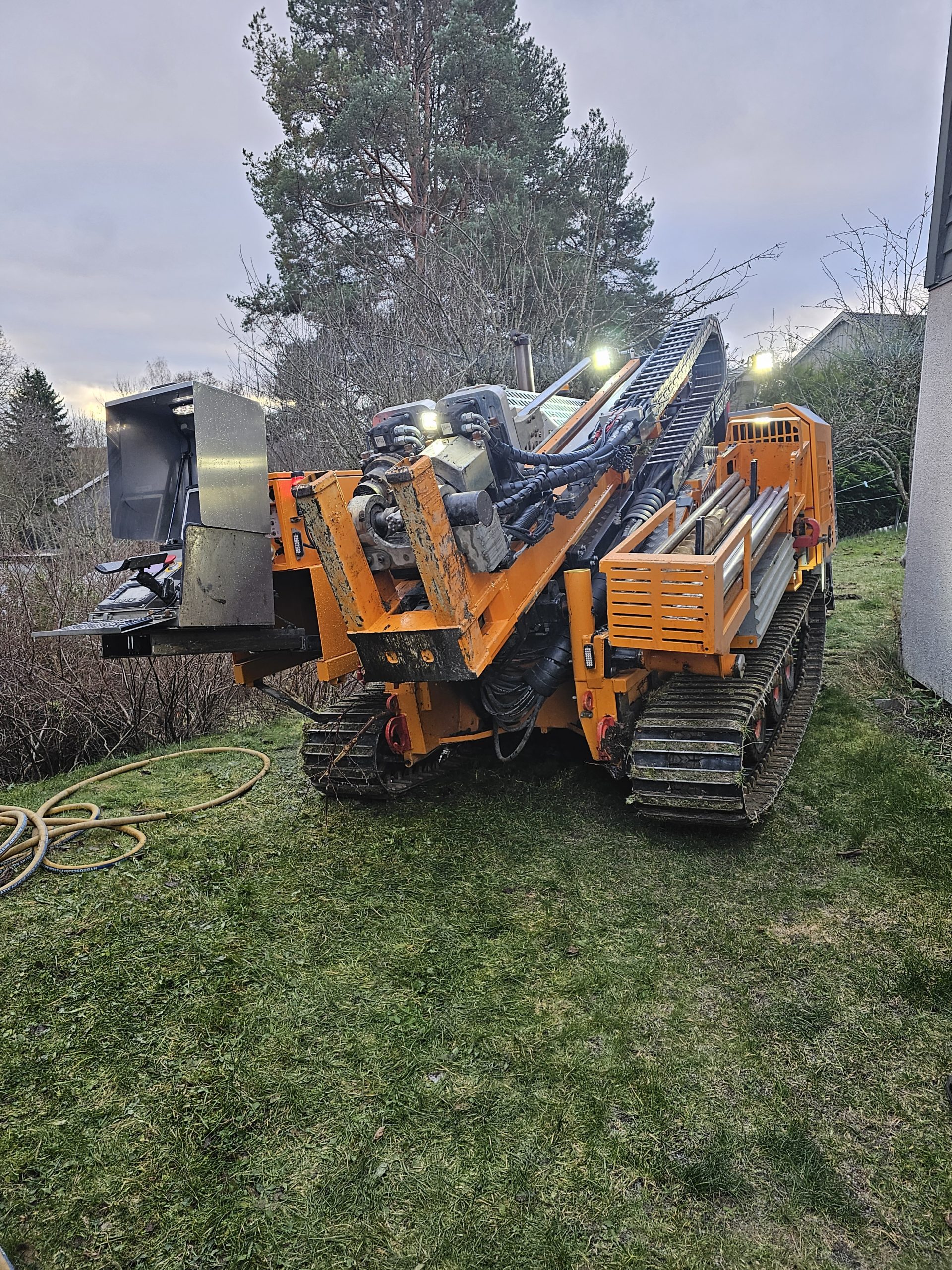
Photo above: from Brobekkveien, Oslo, in 2026, documenting geotechnical fieldwork in practice. The drilling rig shown here was used for total sounding, sampling, piezometer installation and CPTU testing. Such investigations provide important ground data for geotechnical assessments, foundation design and documentation of soil conditions on construction sites.
What is geotechnical drilling?
Geotechnical drilling involves investigating the ground using specialised drilling rigs and testing equipment. The purpose is to obtain information about soil layers, ground resistance, bedrock depth and conditions that may affect construction.
Depending on the project, investigations may include boreholes, penetration testing, soil sampling, laboratory testing and groundwater measurements.
The results are used in geotechnical ground investigations and subsequent engineering assessments. Drilling data alone does not document that the ground is suitable for construction; the findings must be interpreted in relation to the planned development.
Geotechnical borehole drilling and investigation methods
Geotechnical borehole drilling is carried out at selected investigation points to identify ground conditions and obtain information for geotechnical engineering.
Several investigation methods are commonly used in Norway.
Total sounding and depth to bedrock
Total sounding is widely used to investigate soil resistance, variations in ground conditions and depth to bedrock. The method can help identify soft and dense soil layers and provide information about the ground profile.
CPT geotechnical testing and soil sampling
Cone penetration testing (CPTU) measures cone resistance, sleeve friction and pore pressure. This in-situ testing method is particularly useful for investigating soft clay and interpreting geotechnical soil parameters.
Soil sampling may also be required for geotechnical laboratory testing, including the determination of strength, water content and deformation properties.
The appropriate combination of methods depends on the ground conditions, construction project and required level of documentation.
When is geotechnical drilling required?
Geotechnical drilling may be necessary when existing ground information is insufficient to assess foundation conditions, settlement risks or ground stability.
Typical projects include residential and commercial buildings, retaining walls, excavations, roads, infrastructure and construction on soft or uncertain ground.
For building projects, the investigation results can help determine whether conventional foundation solutions are appropriate or whether piling, ground improvement or other measures should be considered.
Not every project requires new drilling. Existing borehole data, previous reports and geological information may sometimes provide a sufficient basis for an initial assessment.
A preliminary geotechnical assessment can clarify whether additional investigations are necessary before design or construction.
Borehole planning and small geotechnical drill rigs
The number, location and depth of investigation points must be adapted to the project and the expected ground conditions.
A properly prepared geotechnical drilling plan identifies suitable investigation locations, testing methods and the information required for subsequent engineering assessments.
Small geotechnical drill rigs may be suitable for sites with restricted access, limited working space or existing buildings close to the investigation points. However, the selected equipment must be capable of carrying out the required investigations.
Existing geotechnical borehole information can also be reviewed before planning new fieldwork. Previous investigations may reduce uncertainty, but results from nearby boreholes are not necessarily representative of the entire construction site.
Geotechnical drilling in clay and quick-clay areas
Ground conditions in Norway can vary considerably over short distances. Construction sites may contain marine clay, glacial deposits, fill materials, soft sediments or shallow bedrock.
Where quick clay may be present, drilling and sounding results require careful interpretation. Relevant soil sampling and laboratory testing may be necessary to establish whether the clay is sensitive or quick.
In areas with slopes or potential landslide hazards, investigations may need to extend beyond the immediate building footprint.
Geotechnical drilling is therefore one component of the assessment and cannot, by itself, document adequate local or area stability.
Geotechnical drilling cost in Norway
Geotechnical drilling cost depends on the scope of the investigation, the required methods and site-specific conditions.
Important cost factors include the number of boreholes, drilling depth, accessibility, mobilisation of equipment, soil sampling and laboratory testing.
For smaller projects, mobilisation can represent a significant proportion of the total investigation cost.
The most appropriate solution is not necessarily the smallest drilling programme. Adequate investigations can reduce uncertainty and the risk of additional costs during foundation design or construction.
Read more about geotechnical investigation costs and the factors affecting the price of ground investigations in Norway.
Geotechnical drilling contractors and engineering consultants
Geotechnical drilling contractors carry out field investigations using drilling rigs and specialised testing equipment.
Geotechnical engineering consultants determine the need for investigations, prepare investigation programmes, interpret the results and assess the implications for construction.
These functions are closely related but are not necessarily performed by the same company.
Geotekniker AS provides geotechnical consulting services in Norway, including assistance with investigation planning, coordination of fieldwork, assessment of soil conditions and geotechnical documentation.
From geotechnical drilling to a geotechnical report
Following the field investigations, the results are normally compiled into a geotechnical data report containing borehole records, sounding diagrams, sampling results and other relevant measurements.
The investigation data can then be used for foundation design, settlement calculations, slope stability assessments and other engineering purposes.
A data report documents the investigation results but does not automatically demonstrate that the planned construction is geotechnically safe.
A separate geotechnical engineering report may therefore be required to provide engineering assessments, calculations, conclusions and recommendations.
Request geotechnical drilling in Norway
Are you planning a construction project and need geotechnical drilling, a ground investigation or a geotechnical report?
Geotekniker AS assists with evaluating existing ground information, determining the need for additional drilling, preparing investigation programmes and assessing geotechnical results.
Contact Geotekniker AS with your project location, site plan and a short description of the planned development.
We can assess what geotechnical investigations and documentation are needed before your project proceeds.
Frequently Asked Questions About Geotechnical Drilling
What is geotechnical drilling used for?
Geotechnical drilling is used to investigate soil layers, depth to bedrock and ground conditions before construction. The results provide essential information for foundation design, settlement assessments and ground stability evaluations.
How much does geotechnical drilling cost in Norway?
Geotechnical drilling costs depend on the number and depth of boreholes, site accessibility, equipment mobilisation and required testing methods. Soil sampling and laboratory testing may increase the total cost. A project-specific investigation programme is normally needed to estimate the price.
Is geotechnical drilling required before building a house?
Not always. The need for geotechnical drilling depends on ground conditions, available investigations and the proposed construction. A preliminary geotechnical assessment can determine whether existing information is sufficient or additional drilling is necessary.
How deep does geotechnical drilling go?
Geotechnical borehole depth varies according to soil conditions, bedrock depth and the purpose of the investigation. Some projects require relatively shallow investigations, while others need deeper boreholes to evaluate foundations, settlement or stability.
What is the difference between CPTU and total sounding?
Total sounding is commonly used in Norway to investigate soil resistance, identify variations in soil layers and determine depth to bedrock. CPTU measures cone resistance, sleeve friction and pore pressure, providing information for interpreting soil properties, particularly in clay deposits.
Does geotechnical drilling confirm that the ground is safe for construction?
No. Geotechnical drilling provides ground investigation data, but the results must be interpreted by a qualified geotechnical engineer. Foundation conditions, settlement and stability may require separate calculations and assessments before construction can proceed.

Fagansvarlig geotekniker og daglig leder i Geotekniker AS. Han har M.Sc. i faststoffmekanikk (UiO) med videreutdanning i geoteknikk (NTNU, OsloMet) og hydrologi (NMBU). Han har 20 års ingeniørerfaring, blant annet fra Det Norske Veritas, hvorav de siste 12 årene er innen geoteknikk, blant annet som kommunegeotekniker i Lørenskog kommune og i Bane NOR. Geotekniker AS har sentral godkjenning fra DiBK i tiltaksklasse 3.