
The investigation identifies potential ground-related risks and provides essential information for foundation design, excavations and ground stability.
Also known as a geotechnical survey or geotekniske grunnundersøkelser in Norway, the investigation may include ground drilling, soil sampling, geotechnical testing and engineering assessments.
Geotekniker AS assists developers, contractors and property owners with geotechnical investigations, ground assessments and technical documentation for construction projects throughout Norway.
What Is a Geotechnical Site Investigation?
A geotechnical investigation determines the subsurface conditions relevant to a proposed construction project. Its purpose is to identify potential risks and establish a reliable basis for engineering decisions.
Typical investigations assess:
- Soil layers and depth to bedrock
- Bearing capacity and settlement potential
- Groundwater and pore pressure conditions
- Soft clay, sensitive clay and potential quick clay
- Slope stability and excavation conditions
- Ground conditions affecting foundation design
The investigation scope depends on the proposed construction, existing geological information and local ground conditions.
Two neighbouring properties may have significantly different subsurface conditions, even when the terrain appears similar.
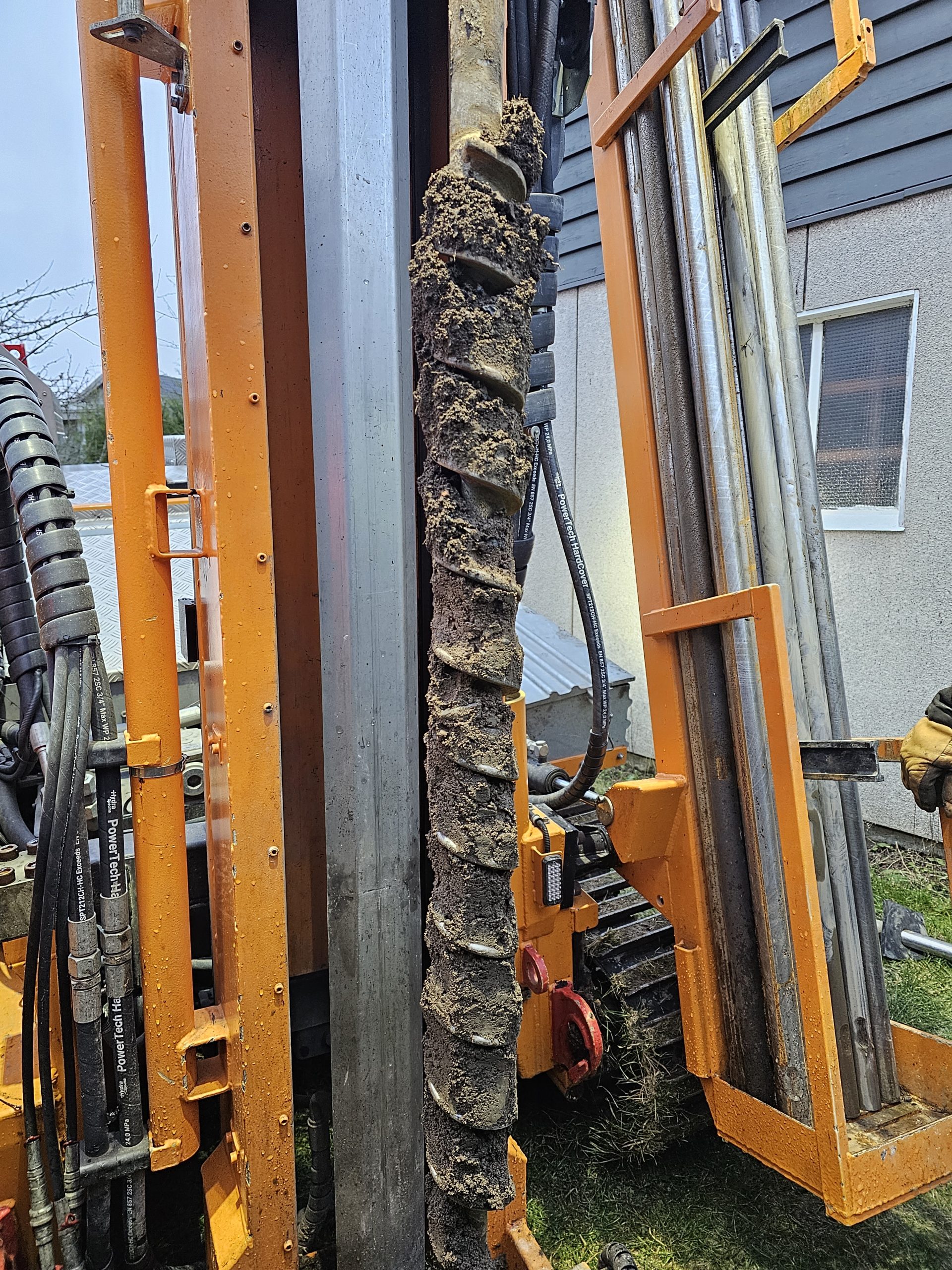
Photo above: This photo documents fill materials encountered during a geotechnical site investigation in Brobekkveien, Oslo, in 2025. It illustrates real ground conditions observed in the field during drilling works and shows how urban sites may contain variable man-made deposits. Practical experience with fill masses is important when assessing foundation conditions, settlement risk and the need for supplementary geotechnical investigations.
When Is a Geotechnical Site Investigation Needed?
Geotechnical site investigations are particularly relevant where ground conditions are uncertain or construction activities may affect soil stability.
Typical projects include residential developments, commercial buildings, infrastructure, retaining walls, excavations and earthworks.
A geotechnical site investigation for housing developments may be required to assess whether the ground can support the proposed structure and whether additional measures are necessary.
Investigations may also be relevant for underground projects involving basement excavations, retaining structures or other work below ground level.
Not every project requires extensive drilling. In some cases, existing ground investigation data and an initial engineering assessment can establish whether further fieldwork is necessary.
Geotechnical Site Investigation Methods
Different geotechnical site investigation methods are selected according to the ground conditions and the engineering questions that need to be answered.
Geotechnical drilling and sounding are used to investigate soil stratification, penetration resistance and depth to bedrock. Common Norwegian methods include total sounding and cone penetration testing with pore pressure measurement (CPTU).
These methods are central to geotechnical ground drilling and provide information for further assessment of subsurface conditions.
Soil sampling and geotechnical laboratory testing are used to determine soil classification, strength, compressibility and other engineering properties. Laboratory analysis may be particularly important where sensitive clay or potential quick clay is present.
Groundwater and pore pressure measurements may be necessary where groundwater conditions influence excavations, ground stability or foundation design.
The investigation programme should be adapted to the project rather than applying the same methods and drilling scope to every site.
Further information is available under ground investigations in Norway.
Geotechnical Site Investigation for Building Foundations
The results of a geotechnical survey provide important information for assessing suitable foundation solutions.
Soft clay, uncontrolled fill, variable bedrock levels and compressible soil deposits may influence foundation selection and the need for ground improvement.
A site investigation can help identify potential bearing capacity limitations, differential settlements and construction-related risks.
For projects involving challenging ground conditions, the investigation results form the basis for further assessments of building foundations and bearing capacity.
The necessary investigation scope should reflect the size of the proposed construction, expected foundation loads and the uncertainty associated with the subsurface conditions.
Geotechnical Site Investigation Report
A geotechnical site investigation report documents the results of field investigations, soil sampling and laboratory testing.
A factual investigation report typically includes borehole locations, sounding results, soil descriptions, laboratory data and relevant groundwater measurements.
A separate interpretative geotechnical report may assess the engineering implications of the investigation results, including bearing capacity, settlement potential, ground stability and foundation recommendations.
The distinction is important because a factual geotechnical survey report does not automatically provide sufficient engineering documentation for a building application or detailed design.
Where additional professional interpretation is required, the investigation data may form the basis for a geotechnical assessment and report.
Geotechnical Site Investigation Guidelines in Norway
Geotechnical site investigations in Norway must be adapted to the applicable technical standards and regulatory requirements.
Eurocode 7 (NS-EN 1997) provides the framework for geotechnical investigation and design, together with the relevant Norwegian national provisions.
The Norwegian Planning and Building Act, particularly Section 28-1, establishes requirements concerning sufficiently safe building ground. The Building Technical Regulations (TEK17) contain additional safety requirements.
Special attention is required where construction may be affected by marine clay, sensitive clay or potential quick clay deposits.
Where there is a potential risk of larger quick clay landslides, investigations may form part of the documentation needed to assess area stability in accordance with TEK17 Section 7-3 and NVE Guideline 1/2019.
There is no universal requirement for a fixed number of boreholes or a standard investigation depth for every development. The necessary scope must be determined based on the actual project and ground conditions.
Geotechnical Survey Cost and Investigation Proposal
The geotechnical survey cost varies depending on site accessibility, investigation methods, borehole depth, laboratory testing requirements and reporting scope.
A geotechnical site investigation proposal should identify the purpose of the work, recommended investigation methods and required deliverables.
Before planning new fieldwork, existing geotechnical information should be reviewed. Previous investigations may be available through NADAG, Norway’s national ground investigation database.
However, existing reports must be assessed for relevance, coverage and quality before being used for a new construction project.
An initial geotechnical assessment can help determine whether supplementary investigations are necessary and avoid unnecessary fieldwork.
From Site Investigation to Geotechnical Engineering
A ground investigation provides factual information about subsurface conditions. Further engineering assessments may be required to determine suitable construction solutions.
Depending on the project, this may include foundation calculations, settlement analysis, slope stability assessments or excavation design.
The investigation data may therefore provide the foundation for subsequent geotechnical design and engineering.
Identifying the necessary documentation at an early project stage can reduce uncertainty and support appropriate engineering decisions.
Geotechnical Site Investigation Services in Norway
Geotekniker AS provides geotechnical engineering services for residential, commercial and infrastructure projects throughout Norway.
Our services include assessment of existing ground investigation data, planning of supplementary investigations, coordination of ground investigation work and preparation of written geotechnical documentation.
We assist with projects involving uncertain ground conditions, foundation requirements, excavations, slope stability and potential quick clay hazards.
Need a geotechnical site investigation or ground assessment in Norway?
Contact Geotekniker AS with your project location, proposed construction work and any existing drawings or investigation reports. We can assess the required geotechnical documentation and whether additional investigations are necessary.
Frequently Asked Questions
What is the difference between a geotechnical survey and a geotechnical site investigation?
The terms are often used interchangeably. Both concern the investigation of subsurface conditions, although a geotechnical site investigation may include a broader programme of drilling, laboratory testing and engineering interpretation.
Is geotechnical drilling always necessary?
No. Existing geological information and previous ground investigation data may sometimes be sufficient. The need for additional drilling depends on the proposed construction and the uncertainty associated with local ground conditions.
What does a geotechnical site investigation report include?
A typical report documents the investigation methods, borehole locations, soil conditions and test results. Engineering interpretations and foundation recommendations may be provided in a separate geotechnical assessment.
How much does a geotechnical site investigation cost in Norway?
The cost depends on the investigation scope, ground conditions, accessibility, testing requirements and reporting. A project-specific assessment is normally needed to determine the appropriate scope and cost.
Who performs geotechnical site investigations?
Geotechnical engineers plan and interpret investigations, specialist drilling contractors normally carry out the fieldwork, and laboratories perform soil testing where required.
Technical references
- Standards Norway – Eurocode 7
- Norwegian Building Authority – TEK17 Section 7-3
- NVE – Quick Clay Landslide Safety Guideline 1/2019
- NGU – National Ground Investigation Database

Fagansvarlig geotekniker og daglig leder i Geotekniker AS. Han har M.Sc. i faststoffmekanikk (UiO) med videreutdanning i geoteknikk (NTNU, OsloMet) og hydrologi (NMBU). Han har 20 års ingeniørerfaring, blant annet fra Det Norske Veritas, hvorav de siste 12 årene er innen geoteknikk, blant annet som kommunegeotekniker i Lørenskog kommune og i Bane NOR. Geotekniker AS har sentral godkjenning fra DiBK i tiltaksklasse 3.