
Laboratory tests provide essential information about soil classification, shear strength, compressibility, consolidation and sensitivity.
In Norway, soil laboratory testing is particularly relevant for construction projects involving soft clay, sensitive soils, settlement risks and challenging ground conditions.
The results are typically used alongside field investigations to support geotechnical assessments, foundation design and documentation of ground stability.
What is geotechnical laboratory testing?
Geotechnical laboratory testing involves analysing soil samples collected from a construction site to determine their engineering properties.
Tests may establish how soil behaves under loading, how much it can compress and whether its strength changes significantly when disturbed.
The scope depends on the soil conditions, the proposed development and the information already available.
In Norway, these investigations are also referred to as geotekniske laboratorieundersøkelser.
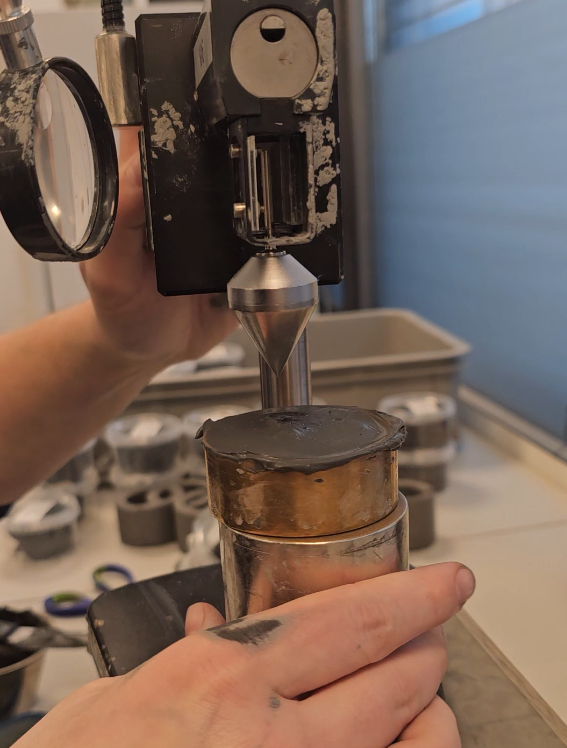
The photograph above shows a fall-cone test on remoulded marine clay during geotechnical laboratory testing. The penetration of the cone into the prepared soil specimen is used to determine the remoulded undrained shear strength. By comparing this result with the undisturbed shear strength, engineers can evaluate soil sensitivity and identify properties associated with sensitive clay and potential quick-clay behaviour. This is particularly important in Norway, where marine clay deposits can present significant geotechnical challenges. Laboratory results provide valuable parameters for assessing ground conditions and stability, but must be interpreted alongside field investigations and other geotechnical data.
Common geotechnical laboratory tests
Different soil laboratory tests are selected depending on the engineering questions that need to be answered.
Soil classification and particle size distribution
Soil classification testing identifies the composition and basic properties of soil, including grain-size distribution, natural water content, density and plasticity.
Particle size distribution is used to identify the proportions of clay, silt, sand and gravel within a soil sample.
For fine-grained soils, Atterberg limits may also be determined to assess plasticity and support soil classification.
Shear strength and triaxial testing
Shear strength testing evaluates the resistance of soil to deformation and failure.
Common laboratory methods include fall-cone testing, unconfined compression testing, direct shear testing and triaxial testing.
Triaxial testing provides information about soil strength and stress–strain behaviour under controlled conditions.
These results may be relevant when assessing foundations, excavations, embankments and slope stability.
Consolidation and oedometer testing
Consolidation in geotechnical engineering describes the time-dependent compression of saturated soil associated with the dissipation of excess pore water pressure.
An oedometer test is used to investigate soil compressibility and consolidation characteristics under one-dimensional loading.
The results are particularly relevant for construction on soft clay and other compressible deposits where settlement may affect buildings or infrastructure.
Soil sensitivity and quick clay testing
Sensitivity is an important geotechnical property when investigating marine clay deposits in Norway.
Laboratory testing may compare undisturbed and remoulded undrained shear strength to determine how significantly the soil loses strength when disturbed.
High sensitivity can indicate potentially problematic ground conditions. Investigations may also be necessary to identify quick clay and evaluate associated stability concerns.
Sensitivity alone does not establish whether soil is quick clay or whether a site is safe. Laboratory results must be interpreted together with other geotechnical information.
Permeability testing
Permeability tests investigate how readily water can flow through soil.
These results may be relevant to seepage, groundwater conditions, drainage, excavation stability and certain ground improvement measures.
The appropriate testing method depends on the soil type and project requirements.
Geotechnical testing – laboratory tests vs. field tests
Geotechnical testing includes both field investigations and laboratory testing.
Field investigations, such as borehole drilling, sounding and cone penetration testing (CPT/CPTU), provide information about soil layers and ground conditions directly at the construction site.
Laboratory testing examines collected soil specimens under controlled conditions and can provide more specific parameters for engineering calculations.
The two methods complement each other. Field data help establish the ground profile, while laboratory results can improve the interpretation of soil behaviour.
A geotechnical site investigation can determine whether additional soil sampling and laboratory testing are necessary.
Geotechnical laboratory equipment and sample quality
Geotechnical laboratory equipment includes fall-cone apparatus, triaxial cells, oedometers and instruments for particle-size and water-content testing.
The reliability of laboratory results depends on the testing procedure, equipment, sample quality and handling.
Sample disturbance during drilling, transport or preparation can affect measured properties, particularly in soft and sensitive clay.
In Norway, relevant laboratory procedures are described in the NS-EN ISO 17892 series and other applicable technical standards.
When is geotechnical laboratory testing needed?
Soil laboratory testing may be appropriate when ground conditions create uncertainty about the safety or performance of a proposed development.
Typical situations include:
- Construction on soft clay or compressible ground.
- Foundations requiring reliable soil strength parameters.
- Excavations, embankments and slope stability assessments.
- Projects where settlement or differential settlement may be significant.
- Areas involving sensitive clay or possible quick clay.
- Developments requiring more detailed geotechnical documentation.
Not every construction project requires laboratory testing. Existing investigations and available ground information may sometimes provide a sufficient basis for an engineering assessment.
The purpose is to obtain the information necessary for the project, rather than conduct unnecessary testing.
Geotechnical laboratory testing cost in Norway
The cost of geotechnical laboratory testing depends on the number of soil samples, the required test methods and the complexity of the investigations.
Basic classification and water-content tests are generally less extensive than advanced strength or consolidation tests.
Drilling, sample collection, laboratory analysis and engineering interpretation may represent separate cost components.
An initial geotechnical assessment can help establish whether additional investigations are justified and which parameters need to be determined.
From laboratory testing to a geotechnical report
Laboratory results must be evaluated together with field measurements, geological information, groundwater conditions and the proposed construction.
The results may support engineering assessments of bearing capacity, settlements, excavation stability and other geotechnical design requirements.
A geotechnical report documents the relevant ground conditions, engineering evaluations and recommendations for the project.
Laboratory testing therefore provides supporting data rather than replacing the professional geotechnical assessment.
Frequently asked questions
What are the most common geotechnical laboratory tests?
Common methods include water-content determination, particle-size analysis, Atterberg limits, fall-cone testing, triaxial testing, oedometer testing and permeability testing.
Is laboratory testing always required for foundations?
No. The need depends on the soil conditions, foundation type, project complexity and available geotechnical documentation.
Can geotechnical laboratory testing identify quick clay?
Laboratory tests can determine properties such as remoulded shear strength and sensitivity that are relevant to identifying quick clay. Assessment of ground stability requires additional information and engineering evaluation.
Who determines which soil tests are necessary?
The testing programme is normally selected by a geotechnical engineer based on the ground conditions, project requirements and available investigation data.
Geotechnical investigations and assessments in Norway
Geotekniker AS provides geotechnical assessments and engineering documentation for construction projects throughout Norway.
We evaluate existing ground information, assess whether additional investigations are needed and interpret geotechnical data as part of written technical assessments.
Our geotechnical services in Norway support developers, contractors, property owners and engineering projects requiring reliable ground assessments.
Contact Geotekniker AS to discuss your project and clarify whether geotechnical laboratory testing, ground investigations or additional documentation may be necessary.

Fagansvarlig geotekniker og daglig leder i Geotekniker AS. Han har M.Sc. i faststoffmekanikk (UiO) med videreutdanning i geoteknikk (NTNU, OsloMet) og hydrologi (NMBU). Han har 20 års ingeniørerfaring, blant annet fra Det Norske Veritas, hvorav de siste 12 årene er innen geoteknikk, blant annet som kommunegeotekniker i Lørenskog kommune og i Bane NOR. Geotekniker AS har sentral godkjenning fra DiBK i tiltaksklasse 3.